Exotics Week: Overgrown Teeth

All rodents and rabbits (technically rabbits are lagomorphs, not rodents) have teeth with open roots that grow throughout their lives.  By chewing on hard objects they naturally wear the teeth down so they don't become too long.  However, sometimes the teeth do become overgrown and this can cause serious problems.

Most people don't look at their pet's teeth, so early signs usually go unnoticed.  It's also impossible to see their molars by simply looking at their mouth, so normally the incisors are the only ones visible.  Therefore problems with the incisors can be noticed by an owner, but not problems with the molars.  So what do you look for?  Really, there are two main signs.  The first is not eating.  Overgrown teeth can rub against the tongue or the inside of the cheeks and cause painful sores.  They can also make normal movement of the mouth difficult, preventing eating.  The other symptom is hypersalivation, commonly called "slobbers".  If either of these are happening, overgrown teeth can be the cause.

Here are some rather dramatic pictures of overgrown incisors in rabbits.
As I mentioned, molars are much harder to see, and usually take special instruments or sedation.  Here are a few pictures in guinea pigs.

If your veterinarian diagnoses your pet with overgrown teeth, they will need to be trimmed.  However, this needs to be done by a vet who knows how to do it and ideally has the proper equipment.  Do NOT let a vet trim your pet's teeth with nail trimmers!  Some vets are in the habit of doing so (and I did this before I learned better), but it is actually dangerous to do.  Nail trimmers can cause the tooth to split along its length, causing even worse problems.  It's also common that once teeth start to overgrow they will periodically need to be trimmed for the rest of the pet's life.  But not doing so can lead to your pet's death.
Exotics Week: Blood Feathers

Anyone who has birds should know about blood feathers.  This isn't a disorder and is a natural part of the feather growth.  However, broken blood feathers can be a big mess.

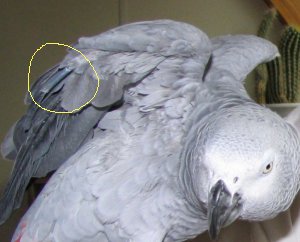
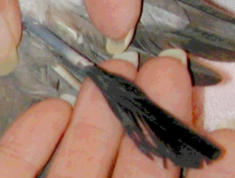
When a new feather starts to grow in, it has blood in the shaft to give nutrients during the growth phase.  The blood gives the shaft a dark blue appearance and is very distinctive.  Here are a couple of pictures.


Once the feather reaches full growth, the blood recedes, leaving the shaft hollow and clear.

Problems can happen when the blood feather breaks.  This can occur when the wing or tail beats against the side of a cage or other hard object, during rough handling, or during a wing trim.  Since the shaft is filled with blood and has a connection to the rest of the circulatory system, there can be a lot of bleeding.  Luckily, there is rarely any life-threatening blood loss.  However, this can be very messy and certainly cause the bird owner a lot of concern.  So if this happens there are a few things you can do at home.

1.  Wait.  Many times the bleeding is minimal and will stop on its own.
2.  Apply flour or cornstarch with some direct pressure at the break.  This isn't quite as good as styptic powder, but virtually everyone has one of these ingredients in their cabinets, so it's something that can be used in a pinch.
3.  If the bleeding won't stop, you can pull the feather out yourself.  This isn't easy for many people, and usually involves one person holding the bird while the other plucks the feather.  At home the best tool is needle-nosed pliers, but a pair of hemostats is easier and what I use in the clinic.  Grab the broken feather at the base and pull hard with a solid, steady yank.  The idea is to pull the feather out on a single pull, rather than drawing it out slowly.  Usually removing the feather stops the bleeding.  If any bleeding remains, do step #2 on the area where the feather used to be.

Exotics Week: Guinea Pig Mites

I see a lot of guinea pigs in my practice and the single most common problem I see in them is skin mites.  Now first I want to clarify that mites and lice are very different.  Mites are microscopic and lice are barely visible.  Though they may have some similarities in causing itching, their behavior and progression are different.

A guinea pig with skin mites is invariably itchy. Sometimes mildly so, but often very significantly so.  In fact, a guinea pig can itch so severely that they will go into full-blown seizures.  This may happen spontaneously or after handling or scratching.  Though the seizures are scary to see, they aren't harmful and will go away once the pet is treated.

These pets will start to have scaly, scabbed skin and will lose hair.  As the disease progresses the skin symptoms will worsen, sometimes to the point of a virtually hairless guinea pig.  Much of the skin may be injured from the pet scratching themselves so deeply because of the itching.

In the early stages it may be difficult to tell whether a guinea pig has skin mites or ringworm (a common skin fungus).  Two tests are normally needed.  The first is a skin scraping where we try to find the mites under the microscope.  However, this is not always fully diagnostic, as the mites may be present but in few enough numbers that they're not easy to find.  A good rule-of-thumb that I use is that if the pet is significantly itchy or is having seizures, it's almost assuredly mites since ringworm doesn't cause severe itching.  If there is any doubt, a fungal culture of some hair samples is needed.  Don't let a vet use a "Wood's lamp" or ultraviolet light on these pets in screening for ringworm.  The principle is that certain species of ringworm will fluoresce an apple-green color under ultraviolet light.  But guinea pigs and other small pets aren't infected by these species, only by species that won't fluoresce.  So though this is a common diagnostic tool in dogs and cats, it's worthless in guinea pigs.

Once a diagnosis is made or significantly suspected, treatment is pretty easy and effective.  Most commonly they will receive injections of ivermectin, a common antiparasitic.  In most cases a series of two injections spaced 10-14 days apart will resolve the problem, though occasionally a third or even fourth injection might be needed.  I've never seen a case that needs more injections that this, so if it's not going away after four injections I'd re-evaluate the case.  I also recommend thoroughly cleaning the cage and replacing all of the bedding twice weekly until the problem is resolved.

All-in-all this is a very rewarding condition to treat, as they almost always get better.

Exotics Week: Metabolic Bone Disease

Continuing with reptiles, let's take a look at another completely preventable condition in captive reptiles...metabolic bone disease.  This disorder involves a lack of proper bone absorption of calcium, resulting in a serious health condition. Though it's primarily seen as a problem in the bones, calcium is also involved in proper muscle contraction so you can see muscle problems as well.

Proper calcium metabolism requires two parts.  First is taking in enough calcium.  Reptiles must be fed specific calcium-rich fruits and vegetables, especially dark green leafy vegetables (kale, spinach, mustard greens, collard greens, etc.).  It's sometimes surprising how many people don't realize that many pet reptiles are mostly herbivores and don't need much in the way of insects as meals.  When those insects are fed, or if the reptile is mostly a carnivore, the prey should be properly prepared.  This can be done by "gut loading", or feeding the prey a nutritionally rich food.  The idea is that when the reptile eats its prey it also ingests the nutrition in that meal's digestive tract.  The other way to properly prepare food is to "dust" it with a calcium powder that can be purchased in any pet store that sells reptile supplies.  No matter how it is accomplished, there must be plenty of calcium in the diet.

However, you could feed nothing but calcium and still have a problem if there isn't proper lighting.  In order for calcium to make it into tissues and bones the body needs vitamin D3.  If there is a deficiency of this vitamin then all the calcium in the world won't do much good.  The body naturally produces this vitamin when stimulated by ultraviolet light.  This is the main reason why you need a full spectrum UV light in any reptile enclosure.  The package of the bulb will state if this is the case, and you should look for statements like "full spectrum UV" or "UVA and UVB".

There are other factors in metabolic bone disease, including kidney and liver disease, too much phosphorous in the diet, or environmental factors that may impair calcium absorption.  But in my experience the biggest reasons for this disorder are diet and lighting.
This is a gradual onset that may not be obvious in the early stages.  But by the final stages these are very sick reptiles and can die if not treated quickly.  Here is a list of the most common symptoms:
  • bowed or swollen legs, or bumps on the long bones of the legs
  • arched spine or bumps along bones of spine
  • softening and swelling of the jaw, sometimes called "rubber jaw"
  • tremors or jerky movements
  • lameness
  • lack of appetite
  • constipation
  • fractures of the bones due to bone weakness
  • lethargy, weakness and even partial paralysis (sometimes unable to lift body off ground)
Treatment usually involves changing the causative factors, improving diet, housing, and lighting.  With seriously ill reptiles they may also need vitamin injections or supplements.  With aggressive supportive care there is a chance of saving them.

Remember yesterday how I said that many common health problems can be prevented with proper care?  Don't forget that.  Like vitamin A deficiency, metabolic bone disease is completely preventable and should rarely happen with properly cared-for reptiles.

Exotics Week: Vitamin A Deficiency

I haven't done a themed week in a while, so it's about time.  Exotic pets are a strong interest of mine to the point where I'm designated as training people in this area in my practice.  I thought I would share some important topics that might help owners of these pets.

The first topic is vitamin A deficiency, mainly seen in turtles.  This is a completely preventable disease, as it's related to improper feeding.  The patient most commonly presents with swollen, puffy eyes and potentially torn or raw skin.  It's also common to have some nasal discharge.  Though lab tests can help establish the pet's health, this is mostly a diagnosis based on exam and clinical history.


Once the diagnosis is made, treatment is pretty simple.  Improve nutrition!  For carnivorous turtles I commonly recommend feeding a piece of liver once weekly.  However, there are some other foods, especially for herbivorous animals.  Here's a list of foods high in vitamin A:
Apricots
Broccoli leaves and flowerets
Cantaloupe
Carrots
Collard greens
Dandelion greens (beware of lawn treatments)
Kale
Mango
Mustard greens
Nectarines
Papaya
Parsley
Peaches
Sweet potatoes
Spinach
Turnip greens
Yellow squash
Liver
Whole fish

However, there is a danger in feeding supplements.  Vitamin A can actually reach toxic levels, so you don't want to feed these vitamin-rich foods exclusively.  Make sure to include them in the normal diet but don't go overboard.

Vitamin A deficiency is a perfect example of one of the main points of exotic pet care.  A large majority of the health problems we see are due to inappropriate husbandry, housing, and diet.  If you have these things well under control you'll be a long way to keeping your pet healthy.

Why So Many Women?

There was a recent article describing why women choose certain professions, especially in medicine.  The study described that one of the biggest determining factors was not an inherent love of the field, but its low cost to families.  The professions that allowed the best balance of work and family are the ones that women are choosing to go into.  And yes, veterinary medicine is one of those fields.  Here's a quote from the article.

Among professions with the fastest-growing proportions of women are veterinary medicine. Because of growth in veterinary hospitals and emergency clinics, vets increasingly have been able to eliminate on-call, night and weekend hours, and to work part-time, Goldin says. The proportion of female grads in vet medicine has soared to almost 80%, from 10% in 1970. In other examples, pharmacy grads are now 60% female, up from 30% in the mid-1970s, Goldin says. And optometry is about 60% female.

The article mentions a second discussion (linked above) that gives the following quote.


Drawing from data on Harvard graduates and on University of Chicago MBA grads, Goldin contrasted MBAs to veterinarians. Fifteen years after college, among those women who have kids, 23% of MBAs weren’t working, versus 3% of MDs and 14% of lawyers. “The MBA lure for women is large; incomes are substantial even though they are lower than those of their male peers. But some women with children find the inflexibility of work insurmountable and leave or become self employed,” she said.
“If women are ‘fleeing’ the corporate and financial sectors, they have been flocking to professions in the health field, particularly veterinary medicine,” she said. “Why? The demands of professional training have not changed. But the practice setting has. Small animal clinics open from 9 a.m. to 6 p.m., six days a week, with no evening and no emergency hours have proliferated. Being a veterinarian has prestige, equivalent to that of a physician. Like some physicians there is considerable room for part-time and flexible work. The training period is less than that for doctors. Veterinarians work lower hours than MBAs and engage in more part-time work sooner in their professional lives.”

Anyone in this field knows that women now dominate the profession.  A man like myself is increasingly becoming a rare find, and this will be even more noticeable as time goes on.  Frankly I don't mind, as I've never really felt like medicine should be in the hands of one gender or another.  But as more women enter veterinary medicine it changes more than the look of a veterinary office.  As the articles mentioned, women want a better work/family balance, and this is resulting in changes in how veterinarians are employed and how practices are run.  This isn't a bad thing, just different.  And I've sometimes wondered why this gender switch is happening, so it's interesting to me to see a likely reason.

Speaking of females entering the profession, I'd like to welcome one to the blogosphere.  There is a new blog by a veterinary student (a woman, of course!) called Vogue Vet that exemplifies these differences.  You certainly will not find me discussing the fashionable accessories of a veterinarian!

Bonding With The Physician

I've come to a good understanding and bond with my own physician.  He's known what I do since I started seeing him and we'll sometimes talk about cases together.  I went to see him today and realized that veterinarians and human doctors have things in common besides our medical training.

He was running late today, and it was almost an hour from the time that I checked in until he came into the room.  Honestly, it didn't bother me.  I always bring a book or something to work on when I have a doctor's appointment, because there's usually a wait.  I'm also well aware of how your schedule can get off-kilter, so I'm very forgiving of other doctors' delays. 

When he entered he apologized for the wait.  Since we sometimes "talk shop" he explained one of the cases that delayed him.  He was seeing a man and talking to him about the health concern.  The patient's wife was also there and when the doctor was finished with her husband she said "Since I'm already here can you take a look at me too?"  I was a little floored by this, as any veterinarian can tell you that this is not uncommon in our profession.  Someone makes an appointment to bring their pet for a visit, then when they arrive they have more than just that one.  Sometimes the other pet is just there for "moral support".  But other times the client says "can you see my other pet also?"  We invariably do see them, as did my own doctor in his situation.  But since that was essentially an additional appointment it sets things behind.  Though I knew it happened to me and my colleagues, I never thought about it happening in the human field.

My doctor also talks to me differently than if I were a normal patient.  He treats me like a colleague, and discusses my cases in medical terms since I can understand on a level higher than most of the people he treats.  We talk about the symptoms and causes, and then discuss the treatment together.  However, I also realize that he knows more about human physiology and treatment than I do, so I defer to his expertise and don't presume to know as much as he does (something not all of my clients in the human medical profession seem to understand).  Really, it's kind of neat to talk to him on this level.

Basically the only difference between veterinarians and physicians is the species we treat.  And it's nice when that's recognized and those barriers come down.


Design by Free WordPress Themes | Bloggerized by Lasantha - Premium Blogger Themes | cheap international calls