 |
A dog with hair loss and a
potbelly due to Cushing's |
On Monday, I had to spend another boring, icky day at the vet's office getting tested for Cushing's. Today Dr. Griswald called Mom and said I "probably" have it. But Mom and I think it's more than probable, because I have so many of the symptoms for it. Well, except Dr. Griswald said there were some other things that I might have instead, but since those things are likely to be worse than Cushing's, Mom and I like to think that Cushing's is what I have.
So we have been doing some in-depth research on this illness, and I am going to try to tell you something about it. But the information we read had lots of big, long, medical words in it, so it's a little hard to understand, at least for me. And Mom only went as far as Biology 102 in college, so it's a little hard for her to understand, too. But we think we have mostly figured out how this disease works, so here's our explanation.
 |
| Adrenal glands |
There are these glands, and they are called the adrenal glands, and they sit right on top of your kidneys. And what these glands do is they make this hormone stuff called cortisol. And what cortisol does is it helps your body deal with inflammation and stress and allergies.
But sometimes a little tumor starts growing, and it might be on one of your adrenal glands, or else it might be in your pituitary gland, which is way up in your head. And this tumor screws everything up so that your adrenal glands make way too much cortisol. Then what happens is you might get a bunch of symptoms, and here's a list of them:
1. Hair loss
2. Thin skin
3. Potbelly
4. Loss of muscle mass
5. Not having any energy
6. Excessive panting
7. Enlarged liver
8. Drinking more water
9. Peeing more
10. Being hungry all the time
11. Getting diseases and infections because your immune system doesn't work right
Anyway, about 80% of Cushing's is caused by a benign tumor on the pituitary gland, and 15% is caused by a tumor on the adrenal gland, and 5% is because the dog was taking steroids or other drugs for too long, like happened to my brother Gabe. And out of the 15% that is caused by adrenal tumors, about 50% of those tumors are cancerous.
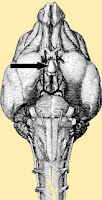 |
| Pituitary gland |
The scientific name for Cushing's is
hyperadrenocorticism, which is a hard word to remember and also to spell, so it's easier to just say Cushing's. The reason it's called Cushing's is because in 1932, the first doctor to describe the clinical syndromes was an American surgeon named Harvey Cushing.
The next thing I have to do is I have to go on Monday to spend most of another boring day at the veterinary clinic. I have to go on Monday because that is the day the radiologist comes, and she is going to do an ultrasound on me. This is mostly to look at my adrenal glands and see if they have any tumors on them, because if they don't, then my Cushing's is what you call "pituitary dependent." If my Cushing's is "adrenal dependent," the doctor can maybe fix it by doing surgery and taking out the tumor. Or maybe they take out the whole adrenal gland. I'm not sure how it works. But one of Aunt Cheryl's dogs, Gracie, had this done to her, and now she is all cured of Cushing's.

But like I mentioned before, only 15% of Cushing's is due to a tumor on the adrenal gland. If mine is caused by a tumor on my pituitary gland, I will just have to take medicine for the rest of my life, which we hope will make me feel better and make my hair grow back. But there can be some side effects sometimes. Which is better than not treating it at all, because if you don't treat it, here's what you can end up with: hypothyroidism, pancreatitis, diabetes, seizures, hypertension, congestive heart failure, blood clots, and liver and kidney failure. Yuck.
Mostly it's middle-aged and older dogs that get Cushing's, with an average age of 10. I don't like being lumped in with all those "old" dogs, since I am only 8-1/2, but nobody asked my opinion. Some people think that girl dogs get Cushing's more than boy dogs do, and also that spayed or neutered dogs get it more often, but these things have not been proven for sure. Some breeds seem to get Cushing's more than others, including poodles, Yorkies, beagles, Boston terriers, boxers, dachshunds, German shepherds, golden retrievers, Labrador retrievers, Scottish terriers, and most other kinds of terriers.
 |
Another dog with hair loss
and a pot belly due to Cushing's |
So that's my sort of simplified explanation of Cushing's, and I hope I didn't say stuff that was all wrong because of not having a medical degree or anything like that. After I have my ultrasound on Monday, I will probably have more news for you.
Oh, and Dr. Griswald said I don't exactly have leptospirosis, but I might have been exposed to it, so I have to go back in 2 or 3 weeks and get tested for that again. Sigh. It's always something!


